
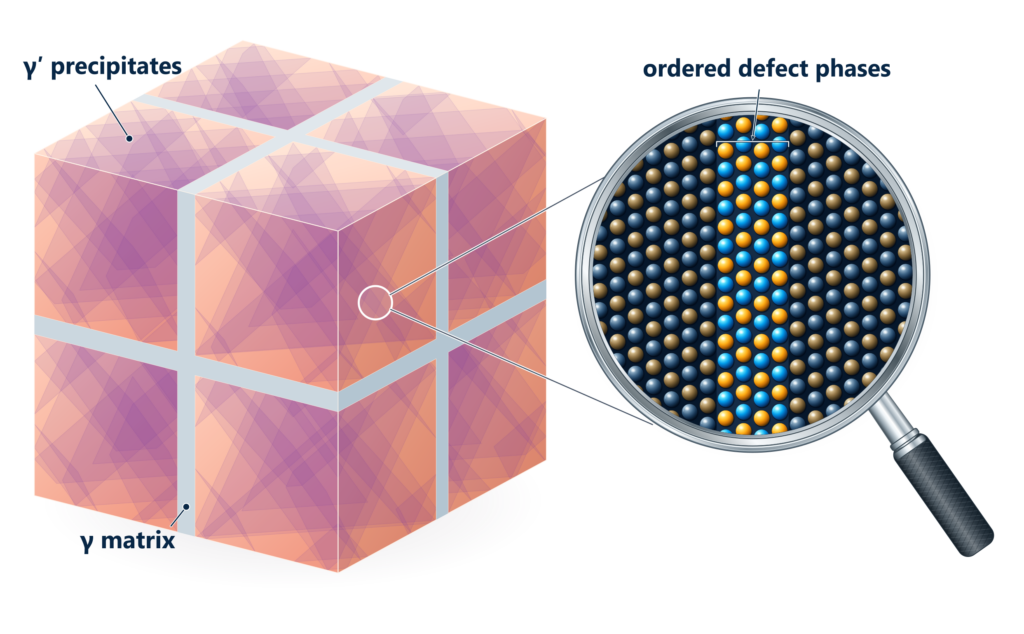
A study published in Science demonstrates a processing route for deliberately creating dense networks of ordered two-dimensional defect phases in structural alloys.
Researchers from the Institute for General Materials Properties (WW1) and the Institute of Micro- and Nanostructure Research (WW9) at Friedrich-Alexander-Universität Erlangen-Nürnberg (FAU), working with The Ohio State University and international partners, have developed a treatment that creates dense networks of ordered strengthening phases in structural alloys. Combining predeformation with subsequent aging allows the researchers to establish these structures before an alloy enters service.
The team investigated a single-crystal CoNi-based and a polycrystalline CoCrW alloy. Predeformation introduces planar defects on multiple slip systems; aging then promotes solute segregation and local chemical ordering. In the superalloy, this produces coherent, atomically thin hexagonal phases confined to stacking faults.
The treatment increased room-temperature strength in compression by more than 200 MPa in the CoNi-based superalloy, even after accounting for predeformation strain. During creep testing at 750 °C, the minimum creep rate fell by more than a factor of three. The immediate plastic strain on applying the load was also suppressed.
The CoCrW alloy illustrates why phase thickness matters. Its thicker, less confined ordered regions increased strength but were associated with reduced work hardening. Designing these networks therefore requires attention to the thickness and confinement of the phases as well as their density.
Electron microscopy and simulations helped explain the strengthening mechanism. Local chemical ordering increases resistance to dislocation motion. In the superalloy, the thin, confined phases remain shearable while impeding slip transmission, allowing the material to retain work hardening at the higher strength level.
The findings provide a processing route for introducing ordered defect phases into alloys capable of forming them. Further work can test how widely the approach applies and how phase density and thickness affect performance. A longer-term question is whether this control over microstructure can deliver equivalent mechanical properties with simpler alloy compositions, and whether doing so offers opportunities for more resource-efficient materials.
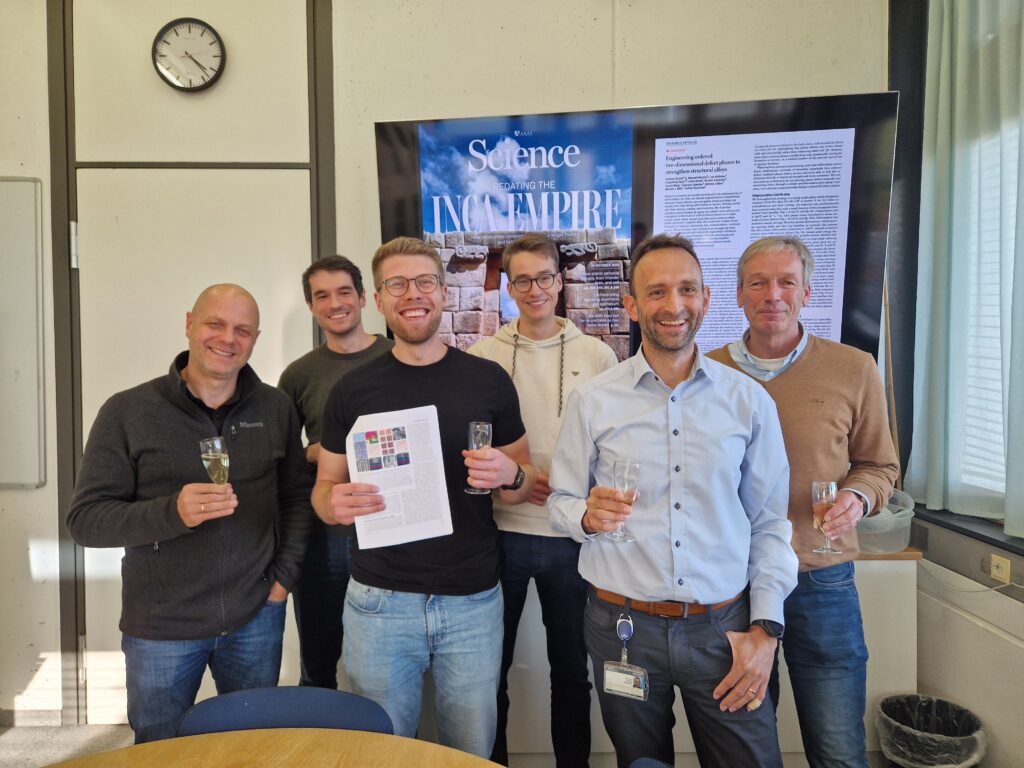
At FAU, the study involved Andreas Bezold, Manuel Köbrich, Jan Vollhüter, Lukas Amon, Mathias Göken and Steffen Neumeier from WW1, as well as Nicolas Karpstein and Erdmann Spiecker from WW9 and the Center for Nanoanalysis and Electron Microscopy (CENEM).