
Current Status
The Department of Materials Science and Engineering consists of nine institutes with 18 full-time professors and approximately 170 research staff, providing outstanding technical breadth across all aspects of materials science in both research and teaching.
Beginnings
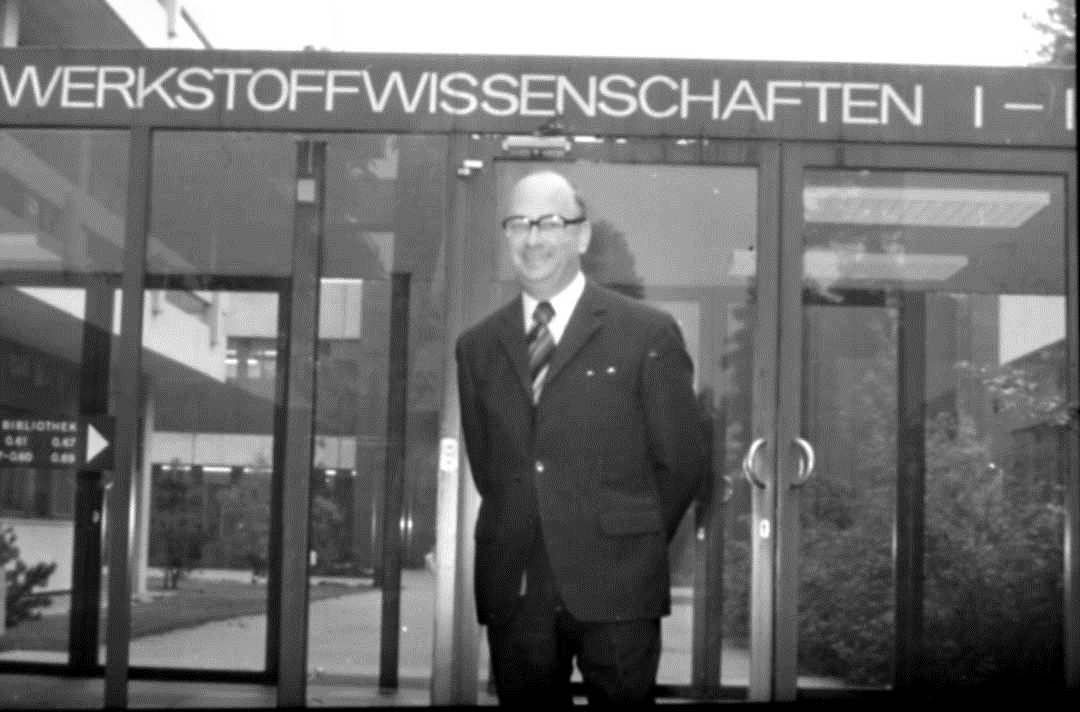
Bernhard Ilschner (Source: WW1)
On the 8th of August 1965, the year before the official founding of the Faculty of Engineering, materials scientist Prof. Bernhard Ilschner was appointed to the Chair of Materials Science I (General Materials Properties).
Professor Ilschner coined the term “Werkstoffwissenschaften” (Materials Science) as a new integrative approach of comprehensive material research and teaching.
Previously, the diverse field of Materials Science had consisted of many individual disciplines such as metallography and metallurgy, iron metallurgy, glass, ceramics, and plastics. This ground-breaking new method for training students was soon adopted by many other institutions.
The Chairs
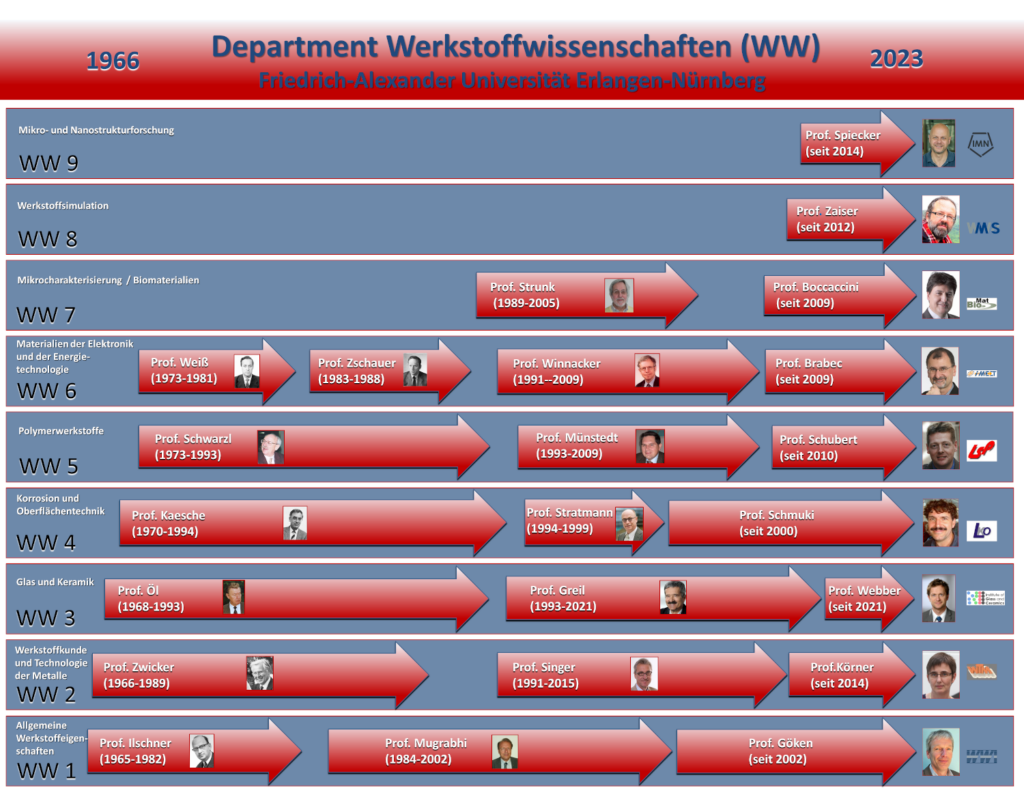
Shortly after the founding of the WWI chair, the next two chairs were established: WW II in 1966 (today Materials Science and Engineering for Metals) and WWIII for Glass and Ceramics in 1968. The first stage of xpansion , to six chairs, occurred in the early seventies with the creation of the chairs of Surface Science and Corrosion (1970), Polymer Materials (1973), and Materials of Electrical Engineering (today Materials for Electronics and Energy Technology) in 1974. In 1989 a seventh chair was added: the Chair of Microcharacterisation. It was changed to the Chair for Biomaterials in 2006. As part of an expansion plan for the exceptionally large high school graduate cohort of 2011, a new chair for Materials Simulation was created in 2010 (situated in the Technikum II in Fürth), and in 2014 the working group Electron Microscopy was expanded into a separate chair by the name of Micro- and Nanostructure Research.
Heads of Chairs
| Chair | Head of Chair |
|---|---|
| WW1: General Materials Properties | Bernhard Ilschner from 1965 through 1982 Hael Mughrabi from 1984 through 2002 Mathias Göken since 2002 |
| WW2: Materials Science and Engineering for Metals | U. Zwicker from 1966 through 1989 Robert F. Singer from 1991 through Oct. 2015 Carolin Körner since Nov. 2011 |
| WW3: Glass and Ceramics | Heribert Oel from 1968 through 1993 Peter Greil from 1993 through 2020 Kyle G. Webber since 2020 |
| WW4: Surface Science and Corrosion | Helmut Kaesche from 1970 through 1994 Martin Stratmann from 1994 through 1999 Patrik Schmuki since 2000 |
| WW5: Polymer Materials | Friedrich Schwarz from 1973 through 1993 Helmut Münstedt from 1993 through 2009 Dirk W. Schubert since 2010 |
| WW6: Materials for Electronics and Energy Technology | Herbert Weiß from 1973 through 1981 Karl Heinz Zschauer from 1983 through 1988 Albrecht Winnacker from 1991 through 2009 Christoph J. Brabec since 2009 |
| WW7: Biomaterials | Horst P. Strunk from 1989 through 2005 Chair Microcharacterisation Mathias Göken (preliminary) from 2005 through 2009 Chair Microcharacterisation Aldo R. Boccaccini since 2009 |
| WW8: Materials Simulation | Michael Zaiser since 2012 |
| WW9: Micro- and Nanostructure Research | Erdmann Spiecker since 2014 |
Infrastructural Development

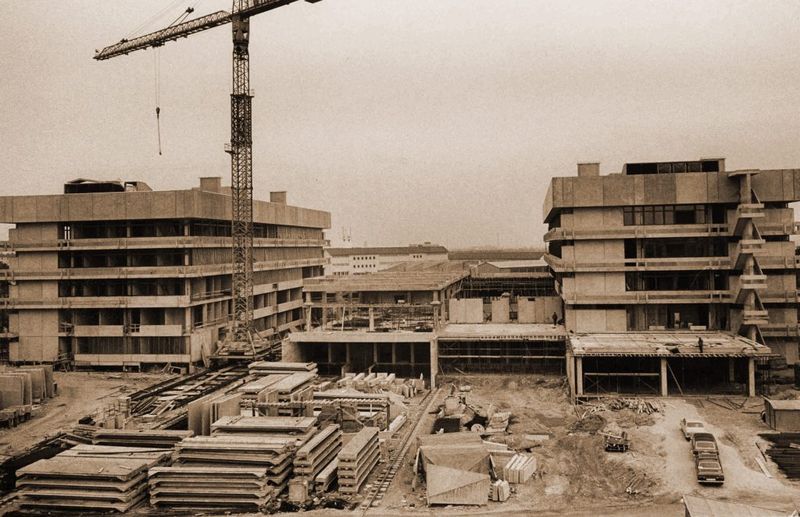
After initial accommodation in low-rise buildings on Egerlandstrasse (now the Department of Mechanical Engineering) and other temporary accommodations, today’s institute building was completed in 1972. Here, six chairs can teach and research in the close proximity within the twin towers and the attached technological workshops. A greatly increased number of students in the department necessitated a long overdue lecture hall andhe former group library was converted into the new Bernhard Ilschner Lecture Hall, honouring the founder of our department.
An important milestone of the department was the beginning establishment of a second material science location in Fürth, starting in 2001. Today, it hosts not only the Neue Materialien Fürth GmbH, (NMF) the Joint Institute of Advanced Materials and Processes (Zentralinstitut für Neue Materialien und Prozesstechnik, ZMP), and the Chair of Materials Simulation but also several working groups of the department.
Further expansion, a countermeasure against an increasing problem of parking availability at the Erlangen campus, continued with thefoundation of the Energy Campus (2010) and the Helmholtz-Institute Erlangen-Nürnberg(HI-ERN) in 201), with strong participation of the Department of Materials Science. The Erlangen division of the Bavarian Center for Applied Energy Research, ZAE, has also been headed by materials scientists since 2005 and has its own new building in close proximity to the Materials Science buildings since 2012.
Furthermore, the foundation of the Center for Nanoanalysis and Electron Microscopy (CENEM) emerged from the Cluster of Excellence “Engineering of Advanced Materials.”
In Erlangen, too, our department has expanded outside the main campus. With the appointment of Prof. Boccaccini to the Chair of Biomaterials, a new building with state-of-the-art equipment for bio research in Erlangen-West was built. It was officially inaugurated in 2016.